Franz Xaver Gruber, 1818
Silent Night Sheet Music
EasyC major
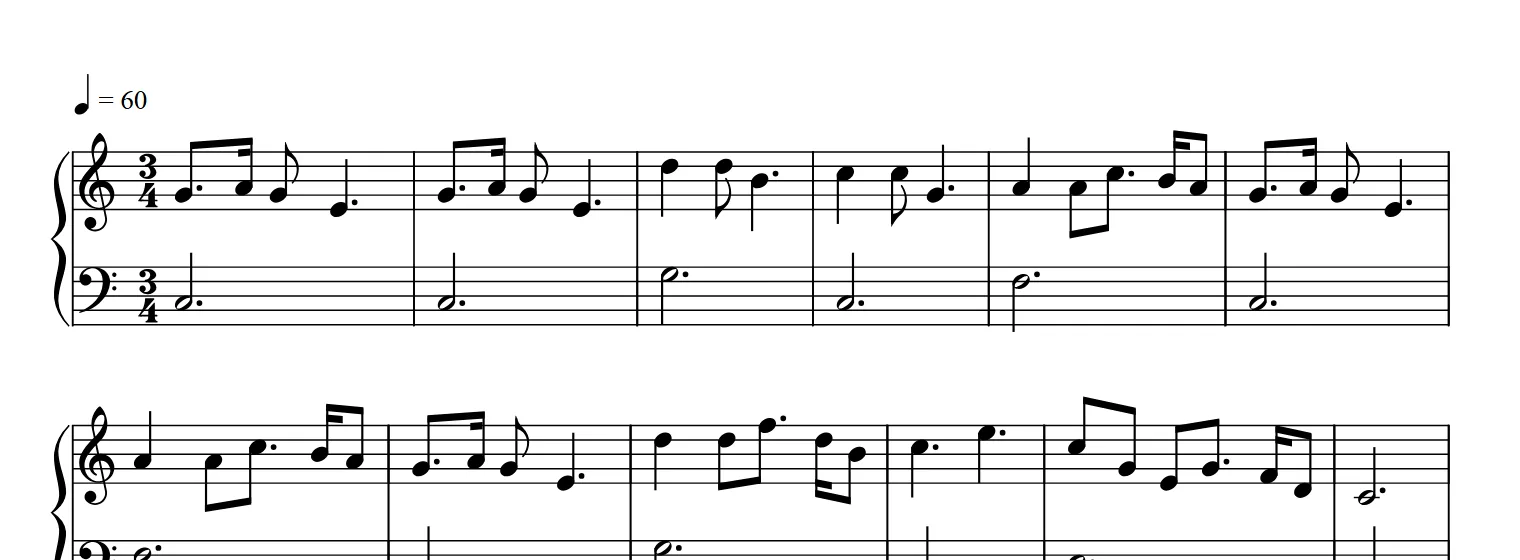
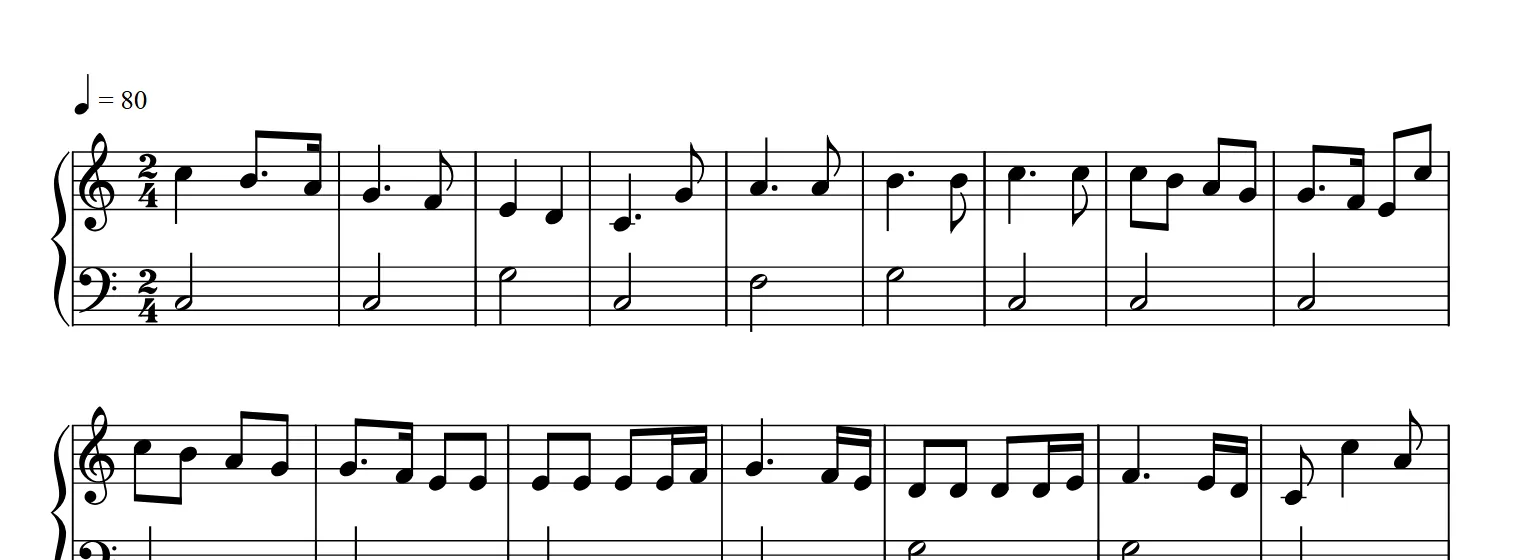
Silent Night in C major, in two versions: an easy piano arrangement for both hands, and the tune alone for a recorder, flute, violin or voice. Listen first, follow the letter notes if the staff is new to you, then print the PDF.
Letter notes, kalimba and recorder
The notes light up as they play.
Letter notes for the tune (right hand). Wider notes are held longer.
For a 17-key kalimba in C. 1 is the long middle tine.
Filled holes are covered. C′ and D′ are the high C and D. Greyed-out notes are beyond the beginner range.
How to play it
- Bars 1, 2, 6 and 8 are the same: a long-short pair, a short note, then a held note. Get that one bar steady and a third of the song is done.
- The widest jump is at the start of bar 9, from E4 up to D5. Practise it slowly with the right hand alone; the highest note, F5, comes in the same bar.
- The left hand has one note per bar, held all the way through: C, C, G, C, F, C, F, C, G, C, E, C. Play it softly so the tune stays in front.
- In bar 12 the right hand rests on middle C for the full three beats. Keep the tempo of 60 and let the note ring until it dies away.
At a glance
- Key
- C major (original key: B-flat major)
- Time signature
- 3/4
- Tempo
- 60 beats per minute
- Length
- 12 bars, about 0:35
- Range
- C3–F5
- Hands
- Both hands
- Level
- Easy
About Silent Night
Silent Night was first sung on Christmas Eve 1818 in the Nikolauskirche at Oberndorf, near Salzburg. Joseph Mohr, the young priest there, had written the poem two years earlier. On Christmas Eve he asked Franz Xaver Gruber, schoolmaster and organist in the next village, for a melody and a guitar accompaniment for that night's mass. The organ builder Karl Mauracher took the song home to the Zillertal, and two travelling families of folk singers, the Strassers and the Rainers, added it to their shows. The notes on this page follow a hymn-book setting of 1908 in the Open Hymnal collection; the tune is Gruber's.
Questions
What key is Silent Night in on this page?
C major. The hymn-book setting this page is based on is in B-flat major; it was moved up a whole tone to C major, which has no sharps or flats and is easier to read.
How long is the piece?
12 bars in 3/4 at 60 beats per minute, about 35 seconds for one pass through the tune.
Can I play it with the letter notes only?
Yes. Open the Piano tab under the sheet: every note of the tune is written as a letter (C D E ...) in the order you play it, right hand first, with a switch to the left hand.
More free sheet music
Traditional, 15th-century French melody
O Come, O Come, Emmanuel
EasyEasy piano · Melody
Open the sheet music
Want your own carol on paper?
Upload a recording (a choir, a piano, a song you love) and get its sheet music. The first 30 seconds are free.
Upload a recordingScore source: Silent Night (Stille Nacht), The Open Hymnal Project (public domain). Easy piano and melody versions arranged by MP3toSheet.